
Union County Court Records After Arrest
After a jail arrest in Union County, the custody record and court record are separate. The jail record shows the booking side: mugshot when available, arrest date, held-for agency, warrants, hold reasons, and bond text. The court record shows what was filed in court and what happened to the case. Arrest charges can be amended, reduced, dismissed, indicted, or replaced by solicitor-filed charges, so the roster is not the final statement of the case.
The local path is arrest, booking at the Union County Detention Center, roster appearance, bond hearing in Magistrate Court, then court filing and prosecution. Lower-level matters may remain in Magistrate or Summary Court. General Sessions-level cases move into Circuit Court and are prosecuted by the Sixteenth Judicial Circuit Solicitor. Booking and custody details belong with Union County jail inmate records, while booking photos are handled separately on the Union County jail mugshots page.
Find Union County Court Records
The main online route is the Union County Public Index. It is part of the South Carolina Judicial Branch court-search system and is the practical starting point for court records after a jail arrest. Court data may lag behind a fresh booking, especially when an arrest occurs after business hours or before a first appearance. If a case does not show at once, search again later and call the appropriate court office when a date, bond, or case-number issue is urgent.
- Open the Union County Public Index or the statewide South Carolina case search landing page.
- Search by party name when the case number is unknown.
- Use the case number when it appears on a warrant, bond sheet, citation, or court notice.
- Open the case entry and compare the filed charge list with the roster hold reasons.
- Check hearing dates, disposition, sentence, and docket entries before treating a charge as final.
The Union County Public Index screenshot shows the case-search screen used for court records after arrest.
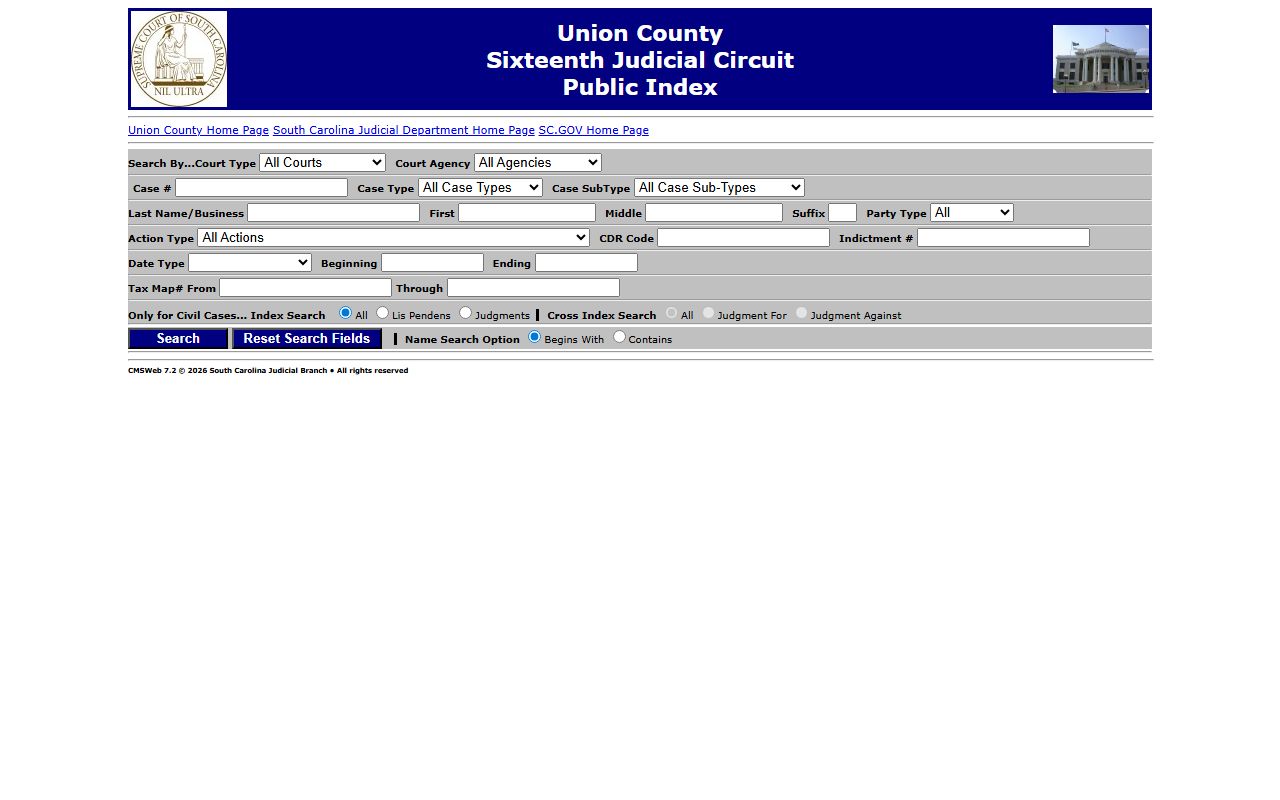
The court index is the better source for filed case status, while the jail roster remains the better source for current custody.
Union County Court Search Fields
The standard South Carolina Public Index structure separates court agencies and search inputs. Field availability can vary by court type, but the visible search controls commonly support defendant name, case number, filing dates, and court-agency selection. Use broad searches first, then narrow by date or court when too many results appear.
| Field Label | Type | Required | Notes |
|---|---|---|---|
| Court Agency / Court Type | Dropdown or tab | No | Can separate Common Pleas, General Sessions, Magistrate, and other indexes. |
| Case Number | Text | No | Best for exact lookup when known from paperwork or a notice. |
| Party Name | Text | No | Use defendant last name and first name when case number is unknown. |
| Business Name | Text | No | Usually not relevant to jail-arrest searches for individuals. |
| Filing Date / Date Range | Date | No | Narrows by filing date once the approximate case period is known. |
| Court Date / Action Type | Date or dropdown | No | Availability depends on the court index screen. |
Union County Arrest Bond Court
The official Union County Magistrate Court page says magistrates issue criminal arrest and search warrants and conduct bail bond hearings two times daily. It also lists preliminary hearings for General Sessions-level cases and criminal hearings for matters such as criminal domestic violence, malicious injury to personal property, trespassing, county ordinance violations, DUI, and driving under suspension. These facts explain why a person may have a jail roster entry before the full court case is easy to read online.
| Bond Type | How It Works in Practice |
|---|---|
| Surety bond | A bondsman or surety can post according to the court's order. |
| Cash bond | Money is posted directly under court or jail instructions. |
| Surety/Cash | The Union portal phrase showing either surety or cash may satisfy the bond. |
| Personal recognizance | Release on a promise to appear, recognized in South Carolina practice though not observed in sampled rows. |
| No bond or denied | Posting money will not release the person unless a court later changes the order. |
| Pending | Bond has not been finalized or the public data has not updated. |
Note: paying a local bond may not release a person with an SCDC, probation, ICE, USMS, or outside-agency hold.
Charges Filed After Arrest
Union County court records after a jail arrest can begin with different charging documents depending on the level and posture of the case. South Carolina uses solicitors, not district attorneys. The Sixteenth Judicial Circuit Solicitor prosecutes Union County General Sessions criminal cases and can decide whether to prosecute, seek indictment, amend or reduce a charge, dismiss a charge, or resolve the case by plea or trial.
| Document | Typical Source | What It Does |
|---|---|---|
| Complaint or warrant | Officer, magistrate, or prosecutor route | Starts or supports an arrest-stage allegation and lower-court process. |
| Information | Solicitor | States formal charges without relying on the roster wording alone. |
| Indictment | Grand jury through General Sessions process | Formal accusation for serious charges moving in circuit criminal court. |
Union County Charge Status
A roster charge is an allegation. A court charge is the filed case record. A conviction requires a plea, verdict, or other adjudication. Court records after arrest should be read by status because the words used at booking can change later. Pending means the case is still open. Dismissed or nolle prosequi means prosecution did not continue on that charge. Amended or reduced means the filed charge changed from the first version.
| Status | Meaning |
|---|---|
| Pending | No final disposition appears yet. |
| Amended | The charge was changed by court or prosecutor action. |
| Reduced | The filed charge moved to a lesser charge or lower level. |
| Dismissed | The charge did not continue to conviction in that case entry. |
| Nolle prosequi | The solicitor declined to continue prosecution on that charge. |
| Convicted | A plea, verdict, or adjudication created a conviction record. |
Warrants Behind Union County Arrests
The sheriff page links to civil processes and warrants, and the Magistrate Court page says magistrates issue criminal arrest and search warrants. A separate official searchable warrant list was not confirmed. The most reliable warrant-adjacent public detail appears after a person is booked, when the roster hold-reasons field may show an arrest warrant number, issuing jurisdiction, statute or code, charge text, arrest date, bond status, and judge.
- Arrest warrant: a court order authorizing arrest on a criminal allegation.
- Bench warrant: a court order often tied to failure to appear or failure to obey a court directive.
- Search warrant: an order authorizing search of property, not an inmate lookup record.
- Fugitive or outside hold: another jurisdiction's warrant or detainer keeping the person in custody.
- Probation/parole hold: a custody block tied to supervision or violation proceedings.
Charges vs Convictions
Union County court records after arrest should never be read as proof of guilt unless the record shows a conviction or other final adjudication. The roster itself states that an arrest does not mean conviction and does not imply guilt or innocence. The court file is stronger than the roster for status, but even a pending court charge is still an accusation.
| Charge | Conviction | |
|---|---|---|
| Stage | Allegation filed after arrest or prosecution review. | Final result after plea, verdict, or qualifying adjudication. |
| Record source | Roster, warrant, Public Index, court file. | Court disposition, sentence, and docket entries. |
| Meaning | Not proof of guilt. | Legal finding or admitted result. |
Sealed and Expunged Records
South Carolina law treats expungement and juvenile records differently from ordinary adult public records. Title 17, Chapter 1 includes expungement and destruction provisions. Title 63, Chapter 19 addresses juvenile justice records, which are more restricted. A dismissed or eligible case may require court, solicitor, and SLED process before public systems change.
| Sealed | Expunged | |
|---|---|---|
| Public access | Hidden or limited from ordinary public view. | Destroyed or removed under an eligible legal process. |
| Who handles it | Court order or statutory limit. | Court, solicitor, and SLED-related process where eligible. |
| Effect on roster copies | May not erase all old third-party copies. | Official systems should follow the court-approved clearing process. |
SLED and Background Checks
South Carolina statewide criminal-history searches are separate from court-record searching. The sheriff's Administrative Services page routes SLED background checks to the SLED site, and the state provides the SLED CATCH portal for criminal-history searches. Local Union County background checks are handled through sheriff administrative services with valid photo ID or driver's license plus a social security card and a $5 cash-only fee during posted weekday hours.
Important: Do not use informal jail or court lookups for credit, employment, tenant, insurance, or other FCRA-covered screening.
Public Record Search
Sponsored Results